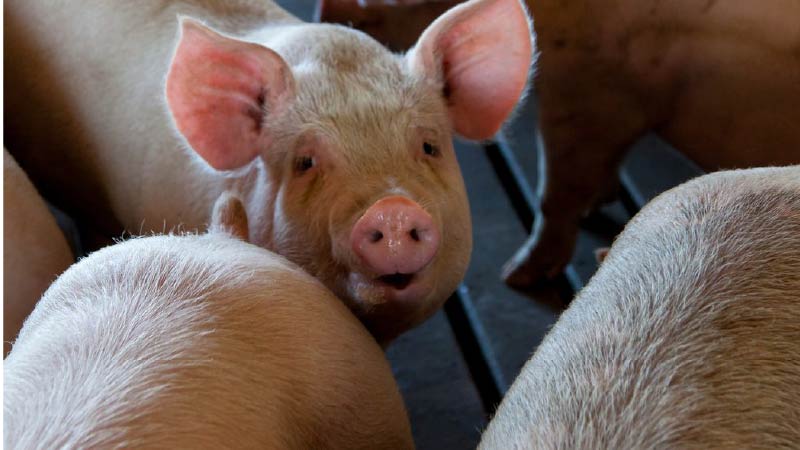

Body Condition Score (BCS) is the single most underused tool in pig breeding. Most smallholder farmers feed all their sows the same amount, ignoring that a thin sow and a fat sow need completely different rations. The result: thin sows fail to conceive, fat sows have small litters and farrowing complications, and nobody knows why productivity is dropping [1][2].
The BCS chart solves this. In 30 seconds, you can score any sow from 1 (emaciated) to 5 (obese) by feeling her hips, spine, and ribs. Combined with FarmWise's BCS logging feature, this gives you a 6-month history of every sow's body condition — letting you spot trends before they cost you money.
The 1-5 body condition chart
| Score | Visual | Touch test | Action |
|---|---|---|---|
| 1 — Emaciated | Hip bones and spine sharply visible. No fat covering. | Hips and spine feel sharp, like knuckles through skin. | Emergency feed increase. Veterinary check. |
| 2 — Thin | Hip bones and spine visible but rounded. | Hips feel prominent but not sharp. Ribs easy to feel. | Increase feed by 0.5 kg/day. |
| 3 — Ideal | Hips barely visible, only when sow moves. Smooth appearance. | Hips feel rounded, requires firm pressure to feel. Ribs need pressure to feel. | Maintain current ration. |
| 4 — Fat | Hips not visible. Square appearance from behind. | Hips hard to feel even with firm pressure. Ribs barely palpable. | Reduce feed by 0.3-0.5 kg/day. |
| 5 — Obese | Huge, no defined shape. Massive fat deposits around neck and tail. | Cannot feel hips or ribs at all. | Reduce feed by 0.5-1 kg/day. May need exercise. |
How to score a sow in 30 seconds
- Stand behind the sow while she is eating or standing quietly. Look at her from behind.
- Look at the hip bones (pelvis). Are they sharp + visible (1-2), barely visible (3), or hidden under fat (4-5)?
- Run your hand along her spine from shoulders to tail. Are the vertebrae sharp (1-2), palpable with pressure (3), or invisible (4-5)?
- Press your fingers against her ribs behind the shoulder. Can you feel individual ribs easily (1-2), with firm pressure (3), or not at all (4-5)?
- Combine the 3 readings. If they differ, take the average and round down.
Why each score matters
Score 1 (emaciated): The sow is metabolizing her own muscle to survive. She will not come into heat, will not conceive if serviced, and may die if not intervened. Causes: underfeeding, parasite burden, disease (chronic pneumonia, erysipelas). Action: increase feed by 1 kg/day, deworm, veterinary check.
Score 2 (thin): Below the conception threshold. Sows at score 2 have a 30-40% lower conception rate than score 3 sows. They also farrow smaller litters (10-11 piglets vs 13-14 for score 3). Action: increase feed by 0.5 kg/day until score 3 reached [1][3].
Score 3 (ideal): Maximum fertility, maximum litter size, easiest farrowing. Target this score at all stages of the reproductive cycle. The only exception: lactating sows typically lose 0.5-1 score during lactation (normal, they're feeding piglets) and regain it during gestation.
Score 4 (fat): Fat sows have smaller litters (10-11 vs 13-14), longer farrowing (more dead piglets), more MMA (mastitis-metritis-agalactia). Fat deposits in the pelvic canal narrow the birth canal — a major cause of piglet mortality. Action: reduce feed by 0.3-0.5 kg/day.
Score 5 (obese): Sows are lame, do not come into heat, may have ovarian cysts. Often culled. Action: reduce feed by 0.5-1 kg/day, encourage movement (large pen, group housing), consider culling if no improvement in 2 cycles.
The 4 critical BCS check moments
- Weaning (day 21-28 post-farrowing). The sow should be at score 2.5-3. If below 2, increase feed by 0.5 kg/day to reach score 3 before service.
- Service (mating). Score 3 is critical. Sows at score 2 will not conceive at the expected rate. Wait 1 estrus cycle (21 days) and re-score before re-service.
- Mid-gestation (day 60). Score 3 maintained. Do NOT let the sow gain too much — overfeeding during gestation causes farrowing problems.
- Pre-farrowing (day 110). Score 3-3.5. Slightly heavier is OK because she'll lose it during lactation. Score 4+ is dangerous — narrow birth canal, more piglets stuck.
Feed adjustment chart by BCS
For an adult sow (~180 kg) on a standard gestation diet (13% protein, 2,800 kcal ME/kg):
| Stage | Score 2 | Score 3 | Score 4 |
|---|---|---|---|
| Gestation day 1-30 | 2.5 kg/day | 2.0 kg/day | 1.5 kg/day |
| Gestation day 31-90 | 2.3 kg/day | 2.0 kg/day | 1.7 kg/day |
| Gestation day 91-110 | 3.0 kg/day | 2.8 kg/day | 2.5 kg/day |
| Lactation (day 1-21) | Ad lib + 1 kg bonus | Ad lib (5-7 kg) | Ad lib (4-5 kg) |
The 5 BCS mistakes that cost the most
- Never scoring at all. "She looks fine" is not a measurement. Score every sow at every critical moment.
- Scoring only visually. Hair coat and skin pigment affect appearance. Always use the touch test — it's 5x more accurate.
- Not adjusting feed. Scoring without acting is useless. Adjust feed the same day you score.
- Ignoring lactation loss. Sows lose 0.5-1 BCS during lactation (normal). Plan for this by allowing the sow to gain slightly during late gestation (3.5 max).
- Waiting too long between checks. A sow can drop from score 3 to score 1.5 in 2 weeks if she stops eating (early disease sign). Score weekly during gestation, daily during lactation.
FarmWise auto-generates a "BCS assessment" task every 30 days for every active breeding sow. Tap complete, enter the score (1-5), and the app tracks each sow's BCS history over time. The Log BCS button (visible on every pig detail page under the breeding tab) lets you score any sow at any time — perfect for the monthly check or the pre-service check.
Sources & References
- [1] National Hog Farmer: Sow Body Condition Scoring — score 3 sows have 13-14 piglets vs 10-11 for score 2 or 4. Source: nationalhogfarmer.com
- [2] Pig333: Body Condition and Reproductive Performance — thin sows have 30-40% lower conception rates, fat sows have more MMA. Source: pig333.com
- [3] Iowa State University Extension: Sow Feeding by Body Condition — adjust feed by ±0.5 kg/day based on BCS. Source: extension.iastate.edu
FarmWise tracks all of this automatically for your farm.
Start free