Poultry lighting is one of the most misunderstood aspects of farm management. Most farmers think light is just so birds can see to eat. In reality, light entering the bird's eye triggers the pineal gland and hypothalamus, which control melatonin, follicle-stimulating hormone, luteinizing hormone, and thyroid hormones. Translation: light controls feeding behavior, growth rate, sexual maturity, and egg production. Get the lighting program wrong and you lose 15-25 percent of potential production. Get it right and you can manipulate bird behavior to maximize profit.
The 5 lighting parameters that matter
- Duration (photoperiod): hours of light per 24-hour period.
- Intensity (lux): brightness at bird level. Layers need 20-30 lux. Broilers need 10-20 lux.
- Color (spectrum): warm (red/orange) stimulates reproduction. Cool (blue/green) stimulates growth and calm behavior.
- Uniformity: light must be evenly distributed. Dark corners cause crowding, aggression, and uneven growth.
- Timing: when the lights come on and off, and how gradually - matters as much as total hours.
Lighting programs by production stage
Broiler chicks (week 1): 23 hours light, 1 hour dark
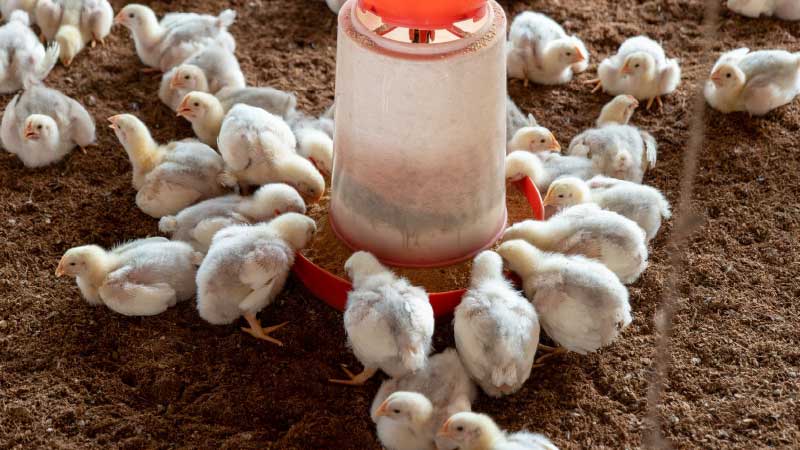
Day-old chicks need to eat frequently to establish gut function and grow. Provide 23 hours of light at 30-40 lux for the first 7 days. The 1 hour of darkness is critical - it teaches birds that darkness happens, so when a power outage occurs later (which it will), birds do not panic and pile up, suffocating each other. Skip this 1-hour training and you risk losing 50-200 birds in a single 4-hour power outage.
Broiler grow-out (weeks 2-6+): 18-20 hours light, 4-6 hours dark
Reduce light to 18-20 hours per day, and reduce intensity to 10-20 lux. This slows growth slightly (good - too-fast growth causes leg problems and ascites) while maintaining feed efficiency. The 4-6 hours of darkness allow melatonin to rise, which supports immune function and reduces stress. Birds consume more feed during light periods to compensate.
Key mistake: many farmers keep broilers on 24-hour light throughout, hoping for faster growth. The result: 5-10 percent higher mortality from metabolic disorders (ascites, sudden death syndrome), leg problems, and overall worse feed conversion despite higher feed intake.
Layer pullets (weeks 0-6): 23 hours light, decreasing
Like broiler chicks, start pullets on 23 hours of light at 30 lux for the first week, then reduce by 1 hour per week until reaching 8-9 hours of light at 6 weeks of age. This slowing photoperiod tells the bird's body to delay sexual maturity - if pullets mature too early (under 16 weeks), they lay small eggs at low rates and have higher mortality.
Layer pullets (weeks 6-17): 8-10 hours light, low intensity
Hold pullets on a short daylength (8-10 hours light, 14-16 hours dark) at 10-15 lux. This delays sexual maturity and lets the bird build bone, muscle, and fat reserves before laying begins. A pullet that enters lay at 18-20 weeks at 1.5kg will outlay and outlive a pullet that enters at 16 weeks at 1.2kg.
Layer stimulation (weeks 17-19): step up light to 16 hours
At 17 weeks, begin stepping up the photoperiod: add 30 minutes per week until reaching 16 hours of light per day. The sudden increase in light duration triggers the hypothalamus to release luteinizing hormone, which triggers ovulation. Egg production begins 2-3 weeks after the photostimulus starts.
Critical: NEVER decrease the photoperiod for laying hens. Once you reach 16 hours, stay at 16 hours for the entire laying period. A drop to 14 hours signals "winter is coming" to the bird's biology, and egg production will crash within 2-3 weeks.
Layer production (weeks 20+): 16 hours light, 8 hours dark
Maintain 16 hours of light per day at 20-30 lux for the entire laying period (typically 12 months). The 8 hours of darkness allow birds to rest and reset melatonin. The 16:8 ratio is the most widely validated program globally.
The light period should ideally be split: 14 hours of natural daylight + 2 hours of artificial light in the early morning (4-6 AM) OR late evening (8-10 PM). Morning light is preferable - it gives birds time to feed before peak heat, and aligns with natural dawn.
Dimmable vs On/Off lighting: which is better?
On/Off lighting (simple timer + bulbs) is the standard for small farms. It costs 5,000-15,000 FCFA (~$25.0) for a basic timer and bulb setup. It works well for broilers and for established layer flocks.
Dimmable lighting (dimmable LED bulbs + sunrise-sunset controller) is more expensive (50,000-150,000 FCFA (~$250) for the controller + bulbs) but offers three advantages:
- Sunrise/sunset simulation: gradual 30-minute ramp-up and ramp-down instead of sudden On/Off. Birds do not pile at the feeder when light suddenly comes on; they wake gradually and feed calmly.
- Precise intensity control: you can reduce light intensity during problem periods (e.g., reduce to 5 lux during feather pecking outbreaks) without changing the program.
- Energy savings: dimming LEDs to 50% intensity uses about 50% of full power - a meaningful savings on a 1,000-bird operation running 16 hours/day.
For most small farmers (under 1,000 birds), On/Off is sufficient. The premium for dimmable pays off above 1,000 birds or for farmers with recurring feather pecking, cannibalism, or flock stress issues.
The 4 most common lighting mistakes
- Using natural daylight only for layers in tropical Africa. At 5 degrees from the equator, daylength varies by only 30 minutes year-round (about 12 hours light, 12 hours dark). Layers need 16 hours of light to peak - so supplemental lighting is mandatory, not optional.
- Light intensity too low. A standard 60-watt incandescent bulb covers about 9m2 at 20 lux. Many farms have too few bulbs or bulbs that are dirty (dust on the bulb reduces effective output by 30-50%). Clean bulbs monthly.
- Light only during evening hours. Farmers often run lights 6 PM-10 PM (4 hours). But total photoperiod is natural daylight + artificial. If natural daylight is 12 hours and you add 4 hours evening, total is 16 hours - good. If you add 4 hours in the morning only, total is also 16 hours - also good. Best is morning light, so birds can feed before peak heat.
- Inconsistent timing. If the timer is off by 30 minutes, or the power goes out for 2 hours and is not made up, birds get confused and production drops. Use a battery-backed timer (5,000 FCFA) and a backup light source (e.g., 1 LED bulb on a small UPS) for power outages.
LED vs incandescent vs fluorescent: which to choose
- Incandescent bulbs: cheap (500 FCFA each), warm color (good for layers), but inefficient (95% of energy is heat, not light) and short-lived (1,000 hours). Need replacement every 6 months of continuous use.
- Compact fluorescent (CFL): medium cost (1,500 FCFA (~$0.83) each), available in warm color, more efficient (4x incandescent), lasts 8,000 hours (1 year of continuous use).
- LED bulbs: expensive upfront (3,000-5,000 FCFA (~$8.33) each), very efficient (10x incandescent), very long life (25,000-50,000 hours, 3-5 years of continuous use), available in any color temperature. Total cost of ownership lowest over 3+ years.
Recommendation: use warm-color (2700K-3000K) LEDs for layers and breeder houses. Use cool-color (5000K-6500K) LEDs for broilers (slightly better growth and calm behavior).
Calculating light cost per bird
For a 1,000-bird layer house needing 16 hours of light per day:
- Average light requirement: 4 watts per m2 at 20 lux with LEDs = 192 watts for 48m2 house.
- Daily energy: 192 watts x 4 hours supplemental (assuming 12h natural daylight) = 768 watt-hours/day.
- Monthly energy: 23 kWh. At 100 FCFA (~$0.17)/kWh (grid price) = 2,300 FCFA (~$3.83)/month.
- Per bird per month: 2.3 FCFA - essentially negligible.
Compare: each bird produces 25 eggs/month at 60 FCFA (~$0.10) = 1,500 FCFA (~$2.50) revenue. The 2.3 FCFA lighting cost is 0.15 percent of revenue. Cutting light to save money is the worst false economy in poultry farming.
The strategic lighting uses that few farmers know
- Forced molting via light manipulation: when a flock's production drops below 50% (around month 10-12 of lay), you can either cull or molt. To molt: reduce light from 16h to 8h for 6 weeks, with restricted feed. The flock stops laying, replaces feathers, then resumes lay at 70-80% production for another 4-5 months. This extends flock life by 30-40% without buying new pullets.
- Brooding heat reduction via light: in hot climates, run brooding lights at lower intensity (20 lux vs 40 lux) - this reduces both electricity use and heat output, lowering the cooling load.
- Color therapy for stress: red light (peak 660nm) calms aggressive birds and reduces feather pecking. Switch to red bulbs for 2-3 days during outbreaks.
- Peak production timing: if you stimulate layers to peak at month 4-6 of lay (during a high-price window like Ramadan or Easter), you capture maximum eggs at maximum price. Time the photostimulation accordingly.
Sources & References
- [1] Layer photoperiod requirements (16 hours light, 8 hours dark) based on universal poultry science standards and FAO Layer Production Guidelines. Source: https://www.fao.org
- [2] Light intensity recommendations (20-30 lux for layers, 10-20 lux for broilers) per Ross and Cobb breeder management guides. Source: https://www.faocodealimentarius.org
- [3] Broiler growth: 38-42g day-old chick to 2.4-2.8kg in 42 days (FCR 1.6-1.8), per industry breeder standards and academic literature. Source: https://pmc.ncbi.nlm.nih.gov
FarmWise tracks all of this automatically for your farm.
Start free