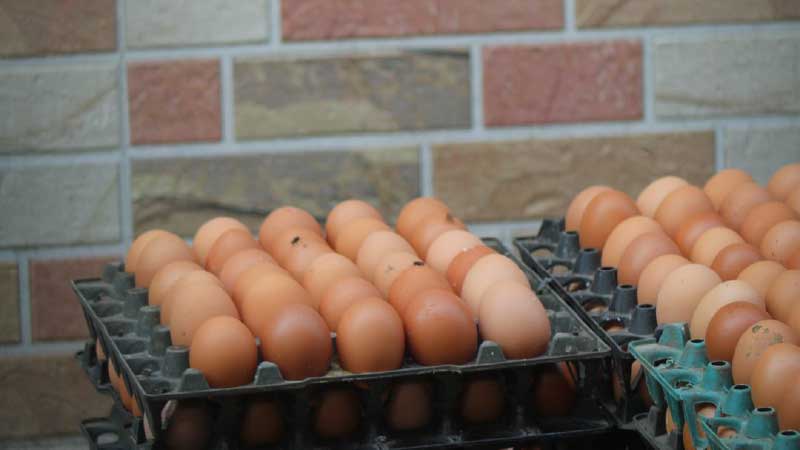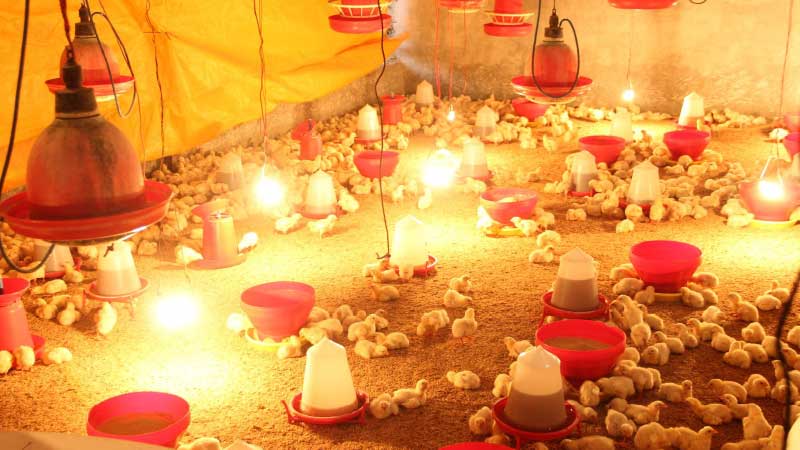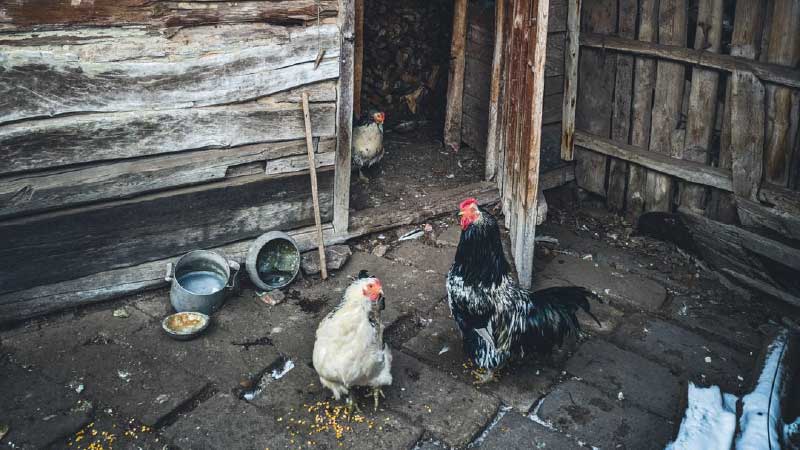
The poultry house is the single largest capital investment most small farmers will make. Get it right and your birds thrive, mortality stays under 4 percent, and the house serves you for 15+ years. Get it wrong and you fight disease, heat stress, and high mortality for the entire life of the house. This article gives you the exact dimensions, materials list, and cost breakdown for a 500-bird layer house (suitable also for 1,000 broilers with minor adjustments) that you can build for under 800,000 FCFA (~$1333) using locally available materials.
The 5 design principles (non-negotiable)
Before any dimensions or materials, understand these 5 principles. Every design decision flows from these:
- Ventilation is more important than space. Birds can tolerate crowding. They cannot tolerate ammonia, humidity, and heat. A well-ventilated small house is far better than a poorly-ventilated large one.
- East-West orientation. The long axis of the house should run east-west. This minimizes direct sunlight hitting the long sides (which face north and south), keeping the interior cooler.
- Floor above ground level. The floor should be at least 15cm above the surrounding ground to prevent flooding during rains and to deter rats from burrowing in.
- Tight roof, open walls. The roof must be solid and leak-proof. The walls can (and should) be partially open for ventilation - covered only with wire mesh and curtains.
- Easy to clean. The floor must be smooth concrete (not earth), the walls must be washable, and there must be a drain for wash water. A house you cannot clean properly will kill your birds within 6 months.
The 500-bird layer house: dimensions and layout
Recommended dimensions for a 500-bird layer house:
- Length: 12 meters (allows 4 internal sections of 3m each for batch separation and easy catching)
- Width: 4 meters (never wider than 5m - cross-ventilation fails in wider houses)
- Wall height: 2.4m at the low side (eaves), 3.0m at the ridge
- Floor: solid concrete, 10cm thick, raised 15cm above ground level, smooth-troweled finish
- Total floor area: 48m2 = 0.096m2/bird (10 birds per m2) - ideal for layers
- Pop holes (bird doors): 2, on the south side, 30cm x 40cm each
- Worker door: 1, on the east gable end, 0.9m x 2.0m
For broilers, the same house can hold 1,000 birds at 20 birds per m2 (broilers tolerate higher density). For breeders, reduce to 5 birds per m2 = 240 birds.
The complete materials list
Here is every material you need, with quantities and indicative prices in FCFA (West/Central African market prices, 2025):
Foundation and floor
- Sand (river sand, clean): 3 cubic meters x 8,000 = 24,000
- Gravel (19mm crushed stone): 2 cubic meters x 12,000 = 24,000
- Cement (42.5R, 50kg bag): 12 bags x 4,800 (Douala) / 5,100 (Yaoundé) = 57,600-61,200
- Damp-proof membrane (polythene sheet, 4m x 12m): 1 roll = 8,000
- Reinforcement mesh (BRC mesh, 6mm, 4m x 12m): 1 sheet = 25,000
- Digging and concreting labor: 80,000
Subtotal: 227,000 FCFA (~$378)
Walls and posts
- Treated timber posts (10cm x 10cm x 3m): 14 posts x 4,500 = 63,000
- Intermediate studs (5cm x 10cm x 3m): 20 x 2,500 = 50,000
- Cement blocks (for lower 60cm of walls, 6-inch hollow blocks): 200 blocks x 350 = 70,000
- Mortar (cement + sand for block laying): 4 bags cement + 1m3 sand = 30,000
- Wall plate (timber, 10cm x 15cm x 4m): 3 pieces x 6,000 = 18,000
- Nails, bolts, brackets: 15,000
- Carpentry labor: 100,000
Subtotal: 346,000 FCFA (~$577)
Roof
- Roof trusses (timber, prefabricated, 4m span): 5 trusses x 12,000 = 60,000
- Purlins (5cm x 7cm x 4m timber): 16 pieces x 2,000 = 32,000
- Corrugated iron sheets (aluminum or aluzinc, 0.4mm thick, 3m long): 18 sheets x 6,500 = 117,000
- Ridge caps: 6 pieces x 2,500 = 15,000
- Roofing nails and felt: 8,000
- Roofing labor: 60,000
Subtotal: 292,000 FCFA (~$487)
Side curtains and wire mesh
- Galvanized wire mesh (25mm, 1m wide, 24m length per side, 2 sides): 2 rolls x 18,000 = 36,000
- Curtain material (heavy-duty tarpaulin, 2m x 12m, 2 sides): 2 pieces x 35,000 = 70,000
- Curtain rails and pulleys: 15,000
- Door (steel or timber, with lock): 1 = 25,000
- Pop hole flaps (timber, hinged): 2 = 8,000
Subtotal: 154,000 FCFA (~$257)
Internal fixtures
- Nipple drinker lines (2 lines x 6m, with 30 nipples each): 2 lines x 35,000 = 70,000
- Tube feeders (30kg capacity): 8 x 8,000 = 64,000
- Perches (for layers, timber 5cm x 5cm x 2m): 6 x 2,500 = 15,000
- Nest boxes (communal, 1m wide, 5 boxes): 5 x 8,000 = 40,000
- Water tank (500L plastic, raised platform): 1 = 45,000
- PVC piping and fittings: 25,000
Subtotal: 259,000 FCFA (~$432)
Grand total
- Foundation and floor: 227,000
- Walls and posts: 346,000
- Roof: 292,000
- Side curtains and mesh: 154,000
- Internal fixtures: 259,000
- TOTAL: 1,278,000 FCFA (~$2130)
This exceeds our 800,000 FCFA (~$1333) target. To bring it down, use earth floor instead of concrete (saves 227,000), local thatch roof instead of iron sheets (saves 200,000 but requires replacement every 3 years), and bamboo or local timber instead of treated posts (saves 40,000). The trade-off: earth-floored thatch-roofed houses have higher mortality and shorter lifespan. The cheaper version costs 740,000 FCFA (~$1233) but lasts 5-7 years instead of 15+.
For most farmers, I recommend the full concrete-floor iron-roof version at 1.28 million FCFA, financed over 3-4 batches. The mortality reduction alone (from 8 percent to 3 percent on a 500-bird batch = 25 birds saved per batch x 2,500 FCFA (~$4.17) = 62,500 FCFA (~$104) per batch saved) pays for the upgrade in 4 batches.
The 7 construction mistakes that ruin poultry houses
- Building too wide. Houses wider than 5m have stagnant air in the center. Keep it narrow.
- North-south orientation. Sun beats directly on the long sides all day, overheating the house. Always east-west.
- Earth floor. Impossible to clean properly, harbors pathogens, attracts rats. Always concrete.
- No curtains. Open mesh 24/7 means birds get cold in harmattan and wet in rain. Install roll-down curtains.
- Roof too low. Roofs under 2.4m at the eaves trap heat at bird level. Minimum 2.4m, ideally 3m.
- Drinker lines under feeders. Causes feed to get wet and moldy. Stagger them.
- Door too small for wheelbarrow. You need to be able to wheel in feed and wheel out litter. Make the door at least 1m wide.
The payback math: how this house earns its cost back
For a 500-bird layer operation, the house at 1.28 million FCFA amortized over 15 years = 85,000 FCFA (~$142) per year, or 7,100 FCFA (~$11.8) per month. Per bird per month, that is 14 FCFA - about 1 percent of the production cost per egg. A well-built house reduces mortality by 4-6 percent (saves 20-30 birds per batch = 100,000-150,000 FCFA (~$250) per batch) and improves feed conversion by 5-8 percent through better temperature control (saves 50,000-100,000 FCFA (~$167) per batch in feed). The house pays for itself in 8-12 months of operation.
Scaling up: cost per bird at different sizes
The cost per bird drops sharply as the house size increases (because fixed costs like doors, water tanks, and labor are spread over more birds):
- 100-bird house: ~6,000 FCFA (~$10.0) per bird of capital cost
- 500-bird house: ~2,500 FCFA (~$4.17) per bird
- 1,000-bird house: ~1,800 FCFA (~$3.00) per bird
- 5,000-bird house: ~1,200 FCFA (~$2.00) per bird
This is why scale matters. If you can possibly build a 500-bird house instead of a 100-bird house, do it - the per-bird capital cost is less than half, and your profit per bird is dramatically higher. Build the largest house you can afford to fill, not the smallest house you can afford to build.
The cheap-but-critical extras
Three small investments that dramatically improve house performance:
- Thermometer (3,000 FCFA): hang one at bird level. Knowing the actual temperature inside your house, you can decide when to roll down curtains or open them fully. Guessing is how birds die in heat waves.
- Hygrometer (5,000 FCFA): humidity is as important as temperature. THI (Temperature-Humidity Index) tells you when your birds are in danger.
- Footbath at the door (5,000 FCFA): see the biosecurity article. The single most cost-effective disease prevention measure.
Sources & References
- [1] Cameroon cement 42.5R price: 4,800 FCFA (Douala) / 5,100 FCFA (Yaoundé) per 50kg bag, per cemnet.com and cameroonnewsagency.com 2024-2025. Source: https://www.cemnet.com
- [2] Cameroon 32.5R cement price: 4,100 FCFA per 50kg bag, per cameroonnewsagency.com. Source: https://cameroonnewsagency.com
- [3] Poultry house design standards based on FAO Poultry Housing Guidelines and academic literature. Source: https://www.fao.org
FarmWise tracks all of this automatically for your farm.
Start free