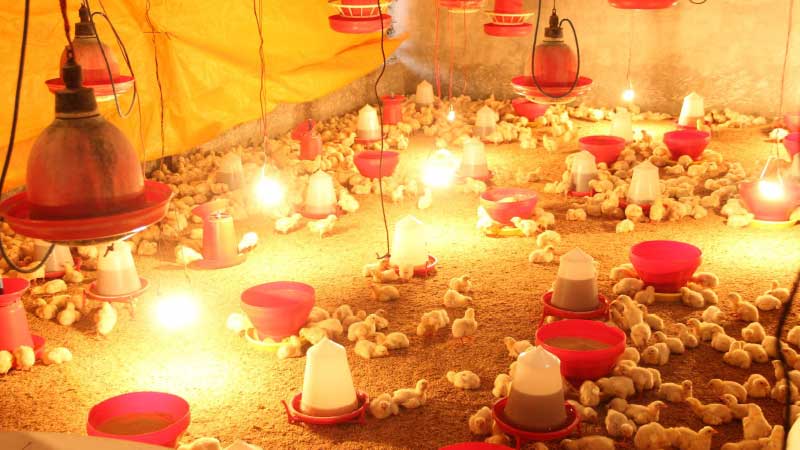

Litter is not just bedding. It is the broiler's environment — the surface they spend 100% of their time on for 5-8 weeks. Wet litter causes foot pad dermatitis, breast blisters, hock burns, and ammonia buildup that damages the respiratory tract. Birds on wet litter eat less, grow slower, and have higher mortality. A 2023 study found that broilers on wet litter weighed 0.4-0.5 kg less at harvest than those on dry litter — that is 1,000-1,500 FCFA lost per bird [1][2].
The 4 causes of wet litter
- Waterer leaks or spills. The #1 cause. A single dripping nipple drinker wastes 5-10 liters per day and saturates the litter in a 1m radius. Check water lines every morning.
- Condensation. When the roof is metal and the night is cold, moisture condenses on the inside of the roof and drips onto the litter. Insulate the roof or use a ceiling.
- Insufficient ventilation. Birds produce 2-3 liters of water per 1000 birds per day just by breathing. If you do not ventilate, that water stays in the litter.
- Dietary imbalance. Excess salt or protein in the feed causes the birds to drink more and produce wetter droppings. Check the feed formulation if the litter is consistently wet.
The day-by-day litter protocol
For a 6-week broiler batch of 500 birds in a 25 m² house (20 birds/m² stocking density):
| Day | Bedding depth | Daily action |
|---|---|---|
| Day -1 (before arrival) | 5-10 cm dry wood shavings | Spread evenly. Test by squeezing a handful — it should not form a clump. |
| Days 1-7 | Maintain 5-10 cm | Spot-clean wet patches around waterers daily. Top up with fresh shavings if needed. |
| Days 8-21 | Maintain 5-10 cm | Rake the litter every 2-3 days to aerate. Remove caked (wet + compressed) areas. |
| Days 22-42 | Add 2-3 cm fresh shavings weekly | Birds are larger, produce more moisture. Top up bedding every 7 days. Rake every 2 days. |
| Day 42+ (harvest) | Remove all litter | Compost for 6 weeks, then use as fertilizer. Do NOT spread fresh poultry manure on crops — it burns them. |
How to test litter moisture without equipment
Grab a handful of litter from the middle of the house (away from waterers). Squeeze hard. Open your hand.
- Litter stays in a ball, damp to the touch: Too wet. Increase ventilation, remove caked litter, add fresh shavings.
- Litter forms a loose ball that crumbles when touched: Perfect moisture (20-25%).
- Litter falls apart immediately, feels dusty: Too dry. Reduce ventilation slightly, check waterer height.
The ammonia test: the smell test
Walk into the broiler house in the morning (after a full night of closed ventilation). Crouch down to bird level and breathe in.
- No smell: Ammonia under 10 ppm. Safe.
- Faint ammonia smell (you can stay 30+ seconds): 10-20 ppm. Increase ventilation immediately.
- Strong ammonia, eyes burn, you cannot stay: Over 25 ppm. DANGEROUS. Birds are being damaged. Remove wet litter, increase ventilation, add fresh dry shavings.
Above 25 ppm ammonia, birds develop respiratory lesions within 48 hours. Above 50 ppm, you will see eye burns and corneal ulcers. A simple ammonia meter costs 25,000-40,000 FCFA — a worthwhile investment if you do more than 3 batches per year [1][3].
Bedding material comparison
| Material | Cost (FCFA/bag) | Absorbency | Verdict |
|---|---|---|---|
| Wood shavings (kiln-dried) | 3,000-5,000 | Excellent | Best option if available |
| Rice husks | 1,000-2,000 | Good | Cheap alternative. Mix 50/50 with shavings. |
| Sawdust (fine) | 500-1,500 | Moderate | OK but cakes easily. Avoid if damp. |
| Peanut shells | Free-1,000 | Good | Use if locally available. Watch for mold. |
| Straw (chopped) | Free | Poor | Avoid for broilers — too slippery, low absorbency. |
The 5 litter mistakes that cost the most
- Putting chicks on litter less than 5 cm deep. Thin litter compresses into a wet mat within 2 weeks. Always start with 5-10 cm.
- Using moldy or damp shavings. Spores cause aspergillosis (respiratory fungus). If shavings smell musty, do not use them.
- Not removing caked litter. Caked litter (compressed wet patches) is a bacterial breeding ground. Remove with a shovel every 2-3 days.
- Closing the house completely at night. Yes, you want to keep heat in, but birds exhale moisture. Leave the ridge vent or top 10 cm of the side curtains open at night.
- Reusing litter between batches. Even if it looks dry, used litter is loaded with bacteria, coccidia oocysts, and ammonia. Always do a full cleanout between batches. Compost the old litter for 6 weeks before using as fertilizer.
FarmWise auto-generates a daily "Top-up litter & remove wet spots" task for every active broiler batch. Tapping it complete and noting the action keeps your batch health record accurate — and tells the next worker that the litter has been checked that day.
Sources & References
- [1] Poultry World: Litter Quality and Broiler Performance — wet litter reduces body weight by 0.4-0.5 kg per bird at harvest. Source: poultryworld.net
- [2] The Poultry Site: Litter Management for Broilers — 5-10 cm bedding depth, daily spot-cleaning around waterers. Source: thepoultrysite.com
- [3] Mississippi State University Extension: Ammonia Levels in Poultry Houses — over 25 ppm causes respiratory lesions within 48 hours. Source: extension.msstate.edu
FarmWise tracks all of this automatically for your farm.
Start free