If there is one thing that separates profitable pig farmers from struggling ones, it is vaccination timing. A piglet that receives iron on day 3, circovirus vaccine on day 14, and mycoplasma vaccine on day 21 has a 95% chance of reaching weaning. A piglet that misses any of these has a 50-70% chance — and the ones that survive will grow slower, eat more feed, and cost you more in vet bills [1][2].
This article gives you the complete, verified piglet health calendar from birth to weaning (70 days). Every date, every dose, every injection site — with the veterinary sources cited so you can verify the information yourself.
Why the calendar matters so much
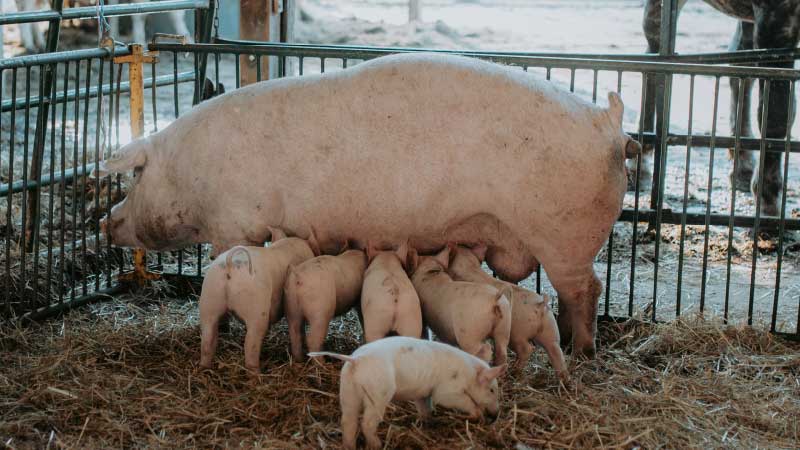
Piglets are born with essentially no immune system. They get their antibodies from colostrum (the first milk) in the first 6 hours of life. After that, they are on their own until their own immune system matures at 4-6 weeks. During this window, they are vulnerable to:
- Iron deficiency anemia — kills 5-15% of piglets in unmanaged farms; piglets are born with only 50mg of iron but need 200mg by 2 weeks
- Coccidiosis — causes diarrhea, stunts growth, kills 10-20% of affected litters
- Circovirus (PCV2) — causes wasting, pneumonia, death; mortality 10-30% in unvaccinated herds
- Mycoplasma hyopneumoniae — causes chronic pneumonia, reduces growth by 10-15%
- Internal parasites (worms) — steal 15-20% of feed, cause stunting
- Erysipelas — causes diamond skin disease, sudden death
Each of these has a specific window when the piglet is most vulnerable and when the intervention is most effective. Missing the window means the intervention may not work — or may come too late.
The complete piglet health calendar (birth to weaning)
Day 1-2: Colostrum + warmth
What to do: Ensure every piglet nurses colostrum within 30 minutes of birth. If the sow has no milk, feed colostrum replacer or cow colostrum via stomach tube (20-30ml per piglet). Provide heat lamp at 33-35°C in the creep area (the piglets' sleeping corner). Piglets that are cold do not nurse, do not get colostrum, and die of hypoglycemia within 12 hours.
Why it matters: Colostrum contains immunoglobulins (IgG, IgA, IgM) that the piglet's gut can absorb only in the first 6 hours. After 24 hours, the gut "closes" and can no longer absorb intact antibodies. Piglets that miss colostrum have no immune protection and almost always die of infection in the first 2 weeks [3].
Day 3: Iron dextran injection (the most critical single intervention)
What to do: Inject 1ml of iron dextran (150mg iron per ml) intramuscularly into the neck muscle (behind the ear, in the muscle, not under the skin). Use a 20-gauge needle, 1/2 inch long. One injection per piglet, on day 3 of life.
The dose: The standard dose is 150mg of iron per piglet, given as 1ml of 150mg/ml iron dextran solution. Some farmers give 200mg (1.3ml), but studies show no significant difference between 150mg and 200mg — 150mg is sufficient [4]. Do NOT give more than 200mg — iron toxicity can cause death.
Why it matters: Piglets are born with only 50mg of iron in their body. Sow milk contains almost no iron. By day 7, the piglet has used up its iron stores. Without supplementation, the piglet develops iron deficiency anemia: pale skin, weakness, poor growth, and death. Iron injection on day 3 prevents this entirely.
Do you need to repeat iron? No. ONE injection at day 3 is sufficient for the entire pre-weaning period. Only repeat if the piglet shows signs of anemia (pale skin, lethargy) at 2-3 weeks — and even then, a second injection of 100mg is enough. Many farmers mistakenly give iron weekly or at 2 months — this is unnecessary and risks iron toxicity [4].
Day 3-5: Coccidiosis prevention
What to do: Give toltrazuril (Baycox) orally at 20mg per kg body weight, once, between day 3 and day 5. The dose for a 1.5kg piglet is approximately 0.5ml of 5% toltrazuril solution. Use a dosing syringe or apply to the back of the tongue.
Why it matters: Coccidiosis (caused by Isospora suis) is the #1 cause of diarrhea in piglets 5-15 days old. It causes yellow, foul-smelling diarrhea, weight loss, and 10-20% mortality in affected litters. Toltrazuril given on day 3-5 prevents the coccidia from multiplying in the gut, preventing the disease entirely.
Day 14: Circovirus (PCV2) vaccine
What to do: Inject 1 dose of circovirus vaccine (e.g., Circovac, Ingelvac CircoFLEX, Porcilis PCV) intramuscularly into the neck muscle. Follow the manufacturer's dose (typically 0.5ml or 1ml, depending on brand).
Why it matters: Porcine Circovirus Type 2 (PCV2) causes Porcine Circovirus Associated Disease (PCVAD), which manifests as wasting, pneumonia, diarrhea, and death. In unvaccinated herds, mortality can reach 30%. Vaccination reduces mortality to <5% and improves growth by 5-10%. This is one of the most cost-effective vaccines in pig farming.
Day 21: Mycoplasma hyopneumoniae vaccine
What to do: Inject 1 dose of mycoplasma vaccine (e.g., Respisure, Ingelvac MycoFLEX, Porcilis M+Hyo) intramuscularly into the neck muscle. Some brands require a booster 2-3 weeks later; check the label.
Why it matters: Mycoplasma hyopneumoniae causes enzootic pneumonia, the most common respiratory disease in pigs. It does not kill directly but damages the lungs, making pigs susceptible to secondary infections (Pasteurella, Actinobacillus). Vaccinated pigs grow 8-12% faster, have 15% better feed conversion, and have 50% less lung damage at slaughter [2].
Day 28: Creep feed introduction
What to do: Start offering a small amount (50-100g per litter per day) of highly palatable creep feed (starter feed, 22-23% crude protein) in a shallow tray in the creep area. Refresh daily. Piglets will start nibbling at 2-3 weeks and seriously eating by 4 weeks.
Why it matters: Creep feed introduction prepares the piglet's digestive system for solid food before weaning. Piglets that have eaten creep feed for 2+ weeks before weaning have 50% less post-weaning diarrhea and grow 20% faster after weaning. This is the single most important preparation for successful weaning.
Day 42 (6 weeks): Pre-weaning weight check
What to do: Weigh each piglet. Target weight at 6 weeks: 8-12kg. Identify slow growers (under 6kg) — they may need extra creep feed or have a health issue. Consider culling runts (under 4kg) — they will not catch up and consume resources.
Why it matters: The piglets that are small at 6 weeks will be small at slaughter. Culling runts early saves feed and space for the pigs that will actually make money.
Day 56 (8 weeks): Deworming + weaning preparation
What to do: Deworm with ivermectin injection (0.3mg per kg body weight, subcutaneously) OR with oral fenbendazole (5mg per kg body weight in feed for 3-5 days). Ivermectin also treats external parasites (mites, lice). Weigh piglets before deworming to calculate accurate dose.
WARNING on deworming: Ivermectin overdose kills piglets. The dose is 0.3mg per kg body weight (1ml per 33kg of piglet). For a 10kg piglet, that is 0.3ml — use a 1ml syringe for accuracy. If you are unsure, ask an experienced farmer or vet to help calculate the dose. Better to underdose slightly than overdose [1].
Why it matters: By 8 weeks, most piglets have some worm burden (ascarids, whipworms, strongyles). Worms steal 15-20% of the piglet's nutrition, causing stunting and poor feed conversion. Deworming at 8 weeks clears the worms before weaning, so the piglet can grow unimpeded.
Day 60-70: Weaning
What to do: Move piglets to the weaning pen. Keep them in the same group (do not mix with unfamiliar piglets — causes stress and fighting). Feed the same creep feed for the first 5-7 days, then gradually transition to grower feed over 7 days. Reduce the sow's feed by 30% for 3 days before weaning to start drying up her milk.
Why it matters: Weaning is the most stressful event in a piglet's life. Sudden feed changes cause diarrhea (post-weaning diarrhea, often E. coli). Gradual transition prevents this. Keeping littermates together reduces stress and fighting.
The calendar at a glance
| Day | Intervention | Dose | Route |
|---|---|---|---|
| 1-2 | Colostrum + heat | 20-30ml colostrum, 33-35°C | Oral + environment |
| 3 | Iron dextran | 1ml (150mg iron) | IM, neck |
| 3-5 | Toltrazuril (coccidiosis prevention) | 20mg/kg BW (0.5ml of 5% solution) | Oral |
| 14 | Circovirus (PCV2) vaccine | 1 dose (0.5-1ml per brand) | IM, neck |
| 21 | Mycoplasma vaccine | 1 dose (per brand) | IM, neck |
| 28 | Creep feed introduction | 50-100g per litter/day | Oral, tray |
| 42 | Pre-weaning weigh-in | Target 8-12kg | Scale |
| 56 | Deworming (ivermectin or fenbendazole) | 0.3mg/kg (ivermectin) or 5mg/kg (fenbendazole) | SC (ivermectin) or oral (fenbendazole) |
| 60-70 | Weaning | Gradual feed transition | Management |
Cost of the full protocol (per piglet, Cameroon prices)
- Iron dextran injection (day 3): ~100 FCFA (~$0.17 USD) per piglet
- Toltrazuril (day 3-5): ~200 FCFA (~$0.33 USD) per piglet
- Circovirus vaccine (day 14): ~500-800 FCFA (~$0.83-1.33 USD) per piglet
- Mycoplasma vaccine (day 21): ~400-600 FCFA (~$0.67-1.00 USD) per piglet
- Ivermectin deworming (day 56): ~50-100 FCFA (~$0.08-0.17 USD) per piglet
Total cost per piglet: ~1,250-1,800 FCFA (~$2.08-3.00 USD)
For a litter of 10 piglets: ~12,500-18,000 FCFA (~$21-30 USD). This is the cheapest insurance you will ever buy. A weaned piglet is worth 45,000-60,000 FCFA (~$75-100 USD) in Cameroon — so for every piglet you save with this protocol, you earn 25-40x the cost of the protocol.
Records: the forgotten half
A vaccination that is not recorded is a vaccination that does not exist. If you cannot produce vaccination records, you cannot: (1) sell breeding stock to other farmers, (2) get livestock insurance, (3) qualify for government compensation during disease outbreaks, (4) export pork to regional markets, or (5) prove to buyers that your animals are healthy. Every vaccination must be recorded with: date, vaccine name, batch number, dose, route (IM/subcutaneous), animal ID, and administrator (you or the vet).
FarmWise auto-generates this entire calendar when you log a farrowing event. Each intervention becomes a task with due date, exact dose, injection site, and a how-to guide. Push notifications remind you the day before each intervention is due. After the intervention is logged, the record is permanently attached to each piglet's health history — ready to export when a buyer or inspector asks for it.
Sources & References
- [1] Prezi: Swine Vaccination and Deworming Protocols — Day 1-3 iron supplementation, 4-10 weeks deworming. Source: prezi.com
- [2] Scribd: Pig Vaccination and Treatment Schedule — Day 3 iron injection prevents anemia; Day 3 anti-coccidials; 1 week Mycoplasma vaccine (Respisure). Source: scribd.com
- [3] WOAH (World Organisation for Animal Health): Colostrum management in piglets — gut closure at 24 hours prevents intact antibody absorption. Source: woah.org
- [4] Pork Business: How and When to Give Iron Injections — 150mg of iron dextran standard; little difference between 150mg and 200mg doses; newborn piglets susceptible to iron deficiency. Source: porkbusiness.com
FarmWise tracks all of this automatically for your farm.
Start free