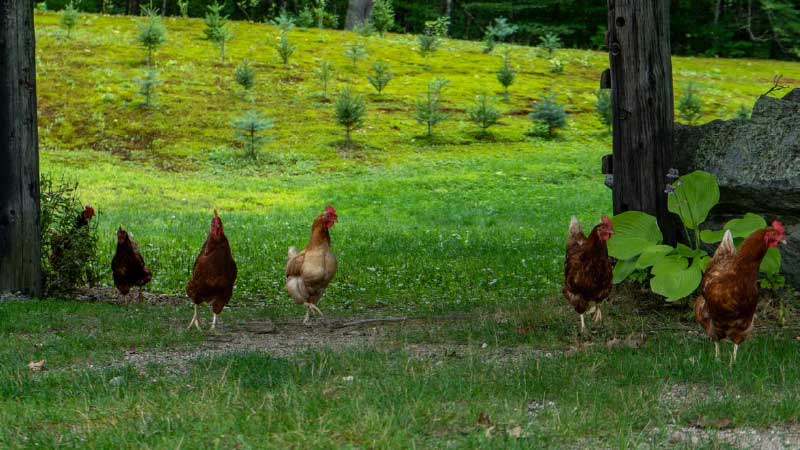
Free-range poultry sounds idyllic. Chickens scratching in the sunshine, eating bugs and grass, living natural lives. The marketing is irresistible. The reality is messier: free-range systems have 4 hidden cost categories that, when added up, often make them MORE expensive per egg than a well-run caged operation. This article is not anti-free-range - it is pro-truth. If you understand the real costs, you can decide whether the marketing premium on free-range eggs justifies the higher production cost.
Hidden cost #1: Predators (8-15 percent mortality per year)
A caged layer operation typically loses 2-4 percent of birds per year to mortality. A free-range operation loses 8-15 percent - and the cause is almost always predators. Hawks attack during the day. Mongooses, snakes, and dogs attack at night. Wild cats and foxes (in some regions) attack any time.
For a 500-bird free-range flock losing 12 percent per year, that is 60 birds. At a pullet cost of 5,500 FCFA (~$9.17) each, you lose 330,000 FCFA (~$550) per year to predators alone - that is 27,500 FCFA (~$45.8) per month, or about 55 FCFA (~$0.09) per egg produced by the surviving birds. That is the price of the "free" in free-range.
Countermeasures: chain-link fencing around the range (200,000 FCFA for a 500-bird range), secure night house with wire mesh on all openings (no gaps larger than 2cm - a mongoose can squeeze through anything bigger), and a guard dog (10,000 FCFA for a puppy, plus feed cost). These countermeasures cost money and partially negate the "low cost" appeal of free-range.
Hidden cost #2: Internal parasites (10-18 percent feed waste)
Free-range birds pick up worm eggs from the soil constantly. Caged birds on wire floors almost never have worm burdens. A free-range layer with a moderate ascarid worm burden eats 10-18 percent more feed for the same egg output - and lays 5-8 percent fewer eggs. Multiply that across 500 birds over a year: an extra 1,800 kg of feed consumed = 504,000 FCFA (~$840) at 280 FCFA (~$0.47)/kg. Plus 4,500 fewer eggs = 270,000 FCFA (~$450) lost revenue at 60 FCFA (~$0.10) each. Total parasite cost: 774,000 FCFA (~$1290) per year, or about 64,500 FCFA (~$108) per month.
Countermeasure: deworm every 8 weeks with levamisole or fenbendazole (cost: ~30 FCFA per bird per treatment, 15,000 FCFA (~$25.0) per 500-bird flock every 8 weeks = 90,000 FCFA (~$150)/year). The dewormer pays for itself 8 times over.
Hidden cost #3: Theft and "disappearance"
Every free-range farmer I have ever spoken to loses birds to theft. The honest number is usually 3-8 birds per month per 500-bird flock, sometimes more during holidays when poultry prices spike. At an average value of 4,000 FCFA (~$6.67) per bird (some are stolen as chicks at 1,500, some as full-grown layers at 6,000), that is 12,000-32,000 FCFA (~$53.3) per month gone. Most farmers do not even realize how much they are losing because they assume the missing bird was taken by a predator or wandered off.
Countermeasure: a perimeter fence with a locked gate, and a farm worker or family member present on the property at all times. If you cannot be there, hire someone - their salary is partially justified by theft prevention alone.
Hidden cost #4: Uneven nutrition and feed waste
Free-range birds do NOT get most of their nutrition from foraging. Studies in tropical Africa show that a free-range layer obtains only 15-25 percent of its daily energy and protein needs from forage - the rest must still come from supplemental feed. Farmers who think "the birds will find their own food" and underfeed supplemental ration lose 30-50 percent of egg production.
Worse, free-range feeding is wasteful: feed tossed on the ground is contaminated by droppings within minutes, gets wet in the rain, and is eaten by wild birds. Estimated feed waste in ground-feeding systems: 15-25 percent. For a 500-bird flock eating 3.5kg per bird per month, that is 1,750kg per month, of which 262-437kg is wasted. At 280 FCFA (~$0.47)/kg, that is 73,000-122,000 FCFA (~$203) per month of wasted feed.
Countermeasure: use hanging tube feeders with rain hoods. Feed twice daily in measured amounts. Never feed ad libitum on the ground.
The real per-egg cost comparison
For a 500-bird layer operation, here is the realistic monthly cost per egg produced (rounded to nearest 5 FCFA):
- Caged system: feed 980,000 + pullet amort 250,000 + labor 200,000 + health 50,000 + electricity 100,000 + depreciation 100,000 = 1,680,000 FCFA (~$2800)/month for ~12,000 eggs = 140 FCFA (~$0.23) per egg.
- Free-range system: feed 1,080,000 (10% more waste) + pullet amort 275,000 (12% mortality) + labor 240,000 (1 extra worker for security) + health 90,000 (deworming + coccidiostat) + predator losses 27,500 + theft losses 22,000 + fence depreciation 16,000 + range maintenance 30,000 = 1,780,500 FCFA (~$2968)/month for ~11,000 eggs (5% fewer eggs due to stress) = 162 FCFA (~$0.27) per egg.
So free-range eggs cost about 22 FCFA more per egg to produce. To justify this, you must sell free-range eggs at a 30+ FCFA premium over caged eggs (25 percent markup minimum). If your market will not pay that premium, free-range is a losing proposition.
When free-range actually makes sense
Three scenarios where free-range beats caged economically:
- You sell to a premium market that pays 30+ percent more for "free-range" or "village eggs" labeling (restaurants, supermarkets, expat communities).
- You run a dual-purpose breed system (e.g. Kuroiler, Sasso) where the male birds are sold as meat and the females as eggs - free-range dual-purpose systems often outperform specialized layer breeds in village settings.
- Your labor cost is zero (you or family members do all the work yourselves and have no opportunity cost for the time).
For everyone else, calculate your true free-range cost per egg honestly before assuming it is cheaper. The romance of free-range farming is real - but it does not pay the bills unless the market pays for the romance.
Sources & References
- [1] Cameroon egg tray (30) retail price: 1,900-2,100 FCFA (government-set, Oct 2023, foodbusinessmea.com); market prices observed at 2,200-2,400 FCFA (Cameroon Tribune). Source: https://www.foodbusinessmea.com
- [2] Layer feed intake 110-130g/day (verified universal veterinary standard, multiple academic sources including sgtdan.co.nz). Source: https://sgtdan.co.nz
- [3] Cameroon day-old chick prices: 800-1,500 FCFA each depending on breed and hatchery, per Quora Cameroun and IPAVIC Facebook posts. Source: https://www.facebook.com
FarmWise tracks all of this automatically for your farm.
Start free