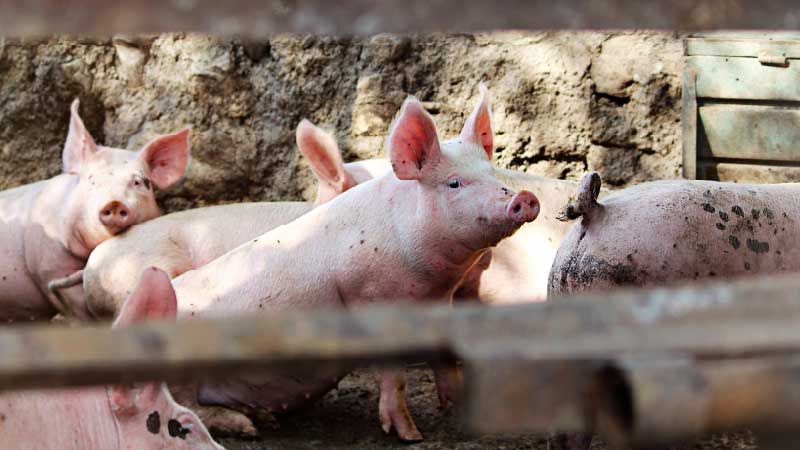
Imagine this: instead of having sows farrow randomly throughout the month — one in week 1, another in week 2, a third in week 3 — ALL your sows farrow within the same 5-day window. The same worker manages all farrowings at once. All piglets are the same age, receive the same vaccines on the same day, are weaned on the same day, and are sold to market as a single batch. This is the power of heat synchronization, and it is the #1 management technique that separates commercial pig farms from hobby farms [1][2].
Heat synchronization means controlling when your sows come into heat (estrus) so they can all be bred within a 3-5 day window. This results in all sows farrowing within the same week (114 days later), which enables "all-in, all-out" batch management — the gold standard for disease prevention, labor efficiency, and profitability [2].
Why synchronize heat?
Random farrowing creates chaos: different-age piglets in the same pen (disease transmission risk), the farmer rushing from one farrowing to another, vaccines given late because you forgot which litter was due, feed calculations that are always wrong because ages are mixed. Synchronized farrowing solves ALL of these problems:
- Labor efficiency: One worker manages all farrowings in the same week, not scattered across the month
- Disease prevention: All-in, all-out batch management means you empty and disinfect the entire farrowing house between batches — breaking disease cycles [2]
- Vaccination precision: All piglets are the same age, so iron injection (day 3), circovirus vaccine (day 14), mycoplasma vaccine (day 21), and deworming (day 56) all happen on schedule, for the entire batch
- Feed efficiency: You buy feed in bulk for the whole batch, not in small bags for mixed-age pigs. One feed formulation for the entire batch.
- Market timing: All piglets reach slaughter weight at the same time — you sell the entire batch at once, negotiate a better price, and time your sales for high-price windows (Christmas, Easter)
- Record-keeping: One batch = one set of records. Much easier to track profitability per batch.
Method 1: Weaning synchronization (the natural method)
The simplest and most natural way to synchronize heat is to wean all sows on the same day. After weaning, sows typically return to heat 3-7 days later (average 4-5 days) [3]. If you wean 5 sows on Monday, they will all come into heat between Thursday and the following Monday — a 5-day breeding window.
How to do it:
- Plan your breeding dates. If you want all sows farrowing in the first week of March, count back 114 days (gestation) = late October breeding. Count back another 28 days (lactation) = sows should farrow in late September of the PREVIOUS cycle.
- Wean all sows on the same day regardless of whether some piglets are slightly older or younger. A 3-day difference in weaning age is acceptable (wean at 21-28 days for most sows; if some are at day 21 and others at day 28, wean them all on day 28).
- Check for heat twice daily starting on day 3 post-weaning. Most sows will show heat between day 3 and day 7 [3].
- Breed each sow when she shows standing heat — this will be within the same 3-5 day window for all sows.
- Expect 80-90% of sows to return to heat within 7 days of weaning. The remaining 10-20% may be delayed (usually due to body condition loss during lactation) — these will come into heat 18-21 days later and can be added to the NEXT batch [3].
Cost: FREE. No drugs, no hormones, just management discipline.
Limitation: Only works for sows that have already farrowed (not for gilts that have never been bred). For gilts, use Method 2.
Method 2: Altrenogest (Regu-Mate / Matrix) for gilts and weaned sows
Altrenogest (sold under brand names Regu-Mate, Matrix, Altresyn) is an orally active synthetic progestin that "pauses" the estrous cycle. When you stop giving it, all sows resume cycling and come into heat within 4-7 days — synchronized [1][4][5].
How to do it:
- Identify gilts or sows you want to synchronize. For gilts: they must be at least 5-6 months old and have had at least one natural heat cycle (so you know they are cycling). For sows: wean them 2-3 days before starting altrenogest.
- Administer altrenogest orally once daily for 14-18 days. The standard dose is 15mg (5ml of Regu-Mate) per sow per day, mixed into the morning feed [4][5]. Each sow gets her own individual dose — do NOT put it in communal feed (some sows will eat more than others).
- Stop altrenogest on day 15-18. All sows will come into heat 4-7 days after the last dose.
- Check for heat twice daily starting on day 4 after the last dose.
- Breed each sow when she shows standing heat (usually days 5-7 after last altrenogest dose) [4].
- Expect 85-95% of sows to come into heat within the 5-7 day window after altrenogest withdrawal [1][4].
Cost: Altrenogest costs approximately 15,000-25,000 FCFA (~$25-42 USD) per 1-liter bottle. At 5ml per day for 15 days per sow, one bottle treats ~13 sows. Cost per sow: ~1,500-2,000 FCFA (~$2.50-3.33 USD).
Limitations: (a) Requires individual dosing (labor-intensive for large herds); (b) altrenogest is not always available in African veterinary pharmacies — check availability before planning; (c) must wear gloves when handling (absorbed through skin); (d) not for pregnant sows (will abort).
Method 3: PG600 (P.G. 600) — hormone injection for rapid induction
PG600 is a combination of pregnant mare serum gonadotropin (PMSG, 400 IU) and human chorionic gonadotropin (hCG, 200 IU) in a single injection. It directly stimulates the ovaries to develop follicles and ovulate, inducing heat within 3-5 days [1].
How to do it:
- Inject PG600 intramuscularly (5ml dose) into the neck of each gilt or sow you want to synchronize.
- Check for heat starting 3 days after injection. Most sows will show heat on days 4-5.
- Breed each sow during standing heat.
- Expect 70-85% response rate — not all sows respond to PG600, especially if they are in poor body condition or have cystic ovaries [1].
Cost: PG600 costs approximately 8,000-15,000 FCFA (~$13-25 USD) per dose (per sow). More expensive than altrenogest but faster (no 14-day treatment period).
Best use: PG600 is ideal for gilts that have not yet had their first heat (pre-pubertal induction), or for sows that have not returned to heat after weaning (>14 days post-weaning with no heat).
Method 4: Boar effect (natural stimulation)
The presence of a mature boar stimulates heat in gilts and sows through pheromones. This is the cheapest synchronization method, though the least precise [1].
How to do it:
- Housing gilts away from boars until 5-6 months of age.
- Move a mature boar (over 10 months old, sexually active) into the gilt area or adjacent pen.
- Within 3-7 days of boar exposure, 60-80% of gilts will show their first heat (puberty induction) [1].
- For weaned sows: Walk the boar past the sows' pens twice daily. Sows in heat will stand at the fence, allowing you to identify and breed them in a tight window.
Cost: FREE (if you already have a boar). Only cost is the boar's feed and maintenance.
Limitation: Least precise — heat will occur over a 7-10 day window rather than 3-5 days. But for small farms, this is often sufficient and costs nothing.
Choosing the right method
| Method | Best for | Cost/sow | Precision | Time |
|---|---|---|---|---|
| Weaning sync | Sows (post-lactation) | FREE | Medium (5-day window) | 3-7 days post-wean |
| Altrenogest | Gilts + weaned sows | 1,500-2,000 FCFA | High (3-day window) | 18 days treatment |
| PG600 | Pre-pubertal gilts, delayed sows | 8,000-15,000 FCFA | Medium (3-5 day window) | 3-5 days post-injection |
| Boar effect | Gilts (puberty induction) | FREE | Low (7-10 day window) | 3-7 days post-exposure |
The synchronized batch management plan
Once you have synchronized your sows, here is the full batch management calendar:
- Day 0: Synchronized breeding (all sows bred within 3-5 day window)
- Day 18-24: Heat check (confirm pregnancy — any sow returning to heat was not bred or lost the pregnancy)
- Day 28-35: Ultrasound pregnancy confirmation
- Day 107 (7 days before farrowing): Move all sows to farrowing pens, wash + disinfect, prepare farrowing kits
- Day 114 (expected farrowing): All sows farrow within a 5-7 day window
- Day 114 + 3: Iron injection for ALL piglets (day 3 of life for each litter)
- Day 114 + 14: Circovirus vaccine for ALL piglets
- Day 114 + 21: Mycoplasma vaccine for ALL piglets
- Day 114 + 28-42 (3-5 weeks): All sows weaned on the same day → start next synchronization cycle
- Day 114 + 56: Deworm ALL piglets
- Day 114 + 70: Wean all piglets, empty and disinfect the entire house
- Day 114 + 150-180: All piglets reach slaughter weight (~80kg) — sell the entire batch
This cycle repeats every 5-6 months (21 days lactation + 114 days gestation + 7 days prep). A farm with 10 sows can run 2 batches per year, producing ~200 piglets annually — all managed with the efficiency of a single synchronized batch.
Common synchronization mistakes
- Inconsistent altrenogest dosing: Missing a day or giving different doses to different sows breaks the synchronization. Must dose EVERY day for 14-18 days, same dose, same time.
- Poor body condition: Thin sows (BCS <3) do not respond well to synchronization. Fatten them up before starting altrenogest or PG600.
- Using altrenogest on pregnant sows: This will cause abortion. Always confirm the sow is NOT pregnant before starting altrenogest (ultrasound at day 28-35 of the previous cycle).
- Not breeding during standing heat: Synchronized sows still need the standing reflex confirmed before breeding. Do not breed on schedule alone — breed on BEHAVIOR.
- Mixing sows of very different parities: First-parity sows (gilts) may respond differently to synchronization than 4th-parity sows. For best results, synchronize sows of similar parity.
FarmWise tracks each sow's cycle, breeding date, expected farrowing date, and auto-generates the batch management calendar above. When you log a synchronized breeding event, the app creates tasks for heat checks, pregnancy confirmation, farrowing preparation, and all piglet health interventions — all at the correct dates for each batch.
Sources & References
- [1] Cluj Veterinary Journal: Researches regarding estrus induction and synchronization in sows — best methods use Regu-Mate (altrenogest) or PG600. Source: clujveterinaryjournal.ro
- [2] 3tres3 (swine industry portal): Weaning on Friday and using altrenogest to avoid weekend farrowing — grouping sows for synchronized mating. Source: 3tres3.com
- [3] Merck Veterinary Manual: Breeding Management of Pigs — most sows exhibit estrus 3-7 days after weaning. Source: merckvetmanual.com
- [4] University of Wisconsin Animal Science: Pig Breeding and Estrus Detection — females synchronized by 14-16 days of oral progestin (Matrix/Altrenogest). Source: ansci.wisc.edu
- [5] CAB Digital Library: Testing the Altresyn Product for Oestrus Synchronization in sows — orally active progestin altrenogest is effective for synchronization. Source: cabidigitallibrary.org
FarmWise tracks all of this automatically for your farm.
Start free