Biosecurity sounds like a fancy word for rich farms. It is not. Biosecurity is simply the set of habits and barriers that stop diseases from entering and spreading on your farm. The big commercial farms spend millions on showers, vehicle dips, and quarantine buildings. You do not need any of that. What you need are 8 specific habits, costing under 100,000 FCFA (~$167) per year, that prevent 80 percent of disease outbreaks. The remaining 20 percent are unavoidable environmental threats (wild birds, wind-borne pathogens) - but they are the minority.
What biosecurity actually means in practice
Diseases enter a farm through 5 routes. Memorize them: (1) people (their shoes, clothes, hands), (2) vehicles (tyres, wheel arches, undercarriages), (3) new animals (carriers of diseases your herd has no immunity to), (4) feed and water (contaminated by rodents, wild birds, or other farms), and (5) equipment (shared tools, needles, syringes). Every biosecurity measure targets one or more of these 5 routes. The 8 habits below cover all 5.
The 8 habits that prevent 80% of outbreaks
Habit 1: Footbath at the farm entrance
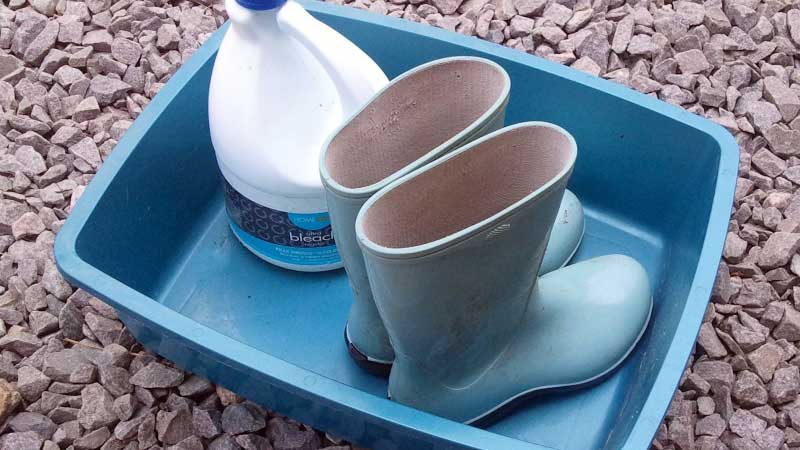
A footbath is a shallow tray of disinfectant solution at the entrance to your poultry house or pig pen. Every person who enters steps in it. This single measure kills 95 percent of the pathogens carried on shoe soles. Cost: a plastic tray (5,000 FCFA), disinfectant concentrate (Virkon S, Iodosan, or a chlorine-based alternative) at 15,000 FCFA (~$25.0) per kilo lasting 3-4 months = 45,000 FCFA (~$75.0) per year. Change the solution every 3 days or when visibly dirty. Mark the date of last change on the wall above the bath.
The mistake most farmers make: filling the footbath once and forgetting it. Disinfectant degrades in sunlight and in contact with organic matter (dirt on shoes). A footbath that has not been changed in 2 weeks is a breeding ground, not a barrier. Rule of thumb: change every 50 visitors or every 3 days, whichever comes first.
Habit 2: Farm-only boots and clothes
Keep one pair of boots and one set of clothes at the farm entrance. Wear them only inside the farm, take them off when you leave. Cost: 2 pairs of rubber boots (12,000 FCFA), 2 sets of overalls (15,000 FCFA). Total: 27,000 FCFA (~$45.0) once, plus replacement every 2-3 years. This single habit stops the most common disease entry route: pathogens carried on the farmer's own shoes from the market, the agrovet shop, or a neighbor's sick farm.
Habit 3: Quarantine all incoming animals for 14 days
Any new animal brought to your farm - whether a breeding boar, a replacement gilt, a batch of layer pullets, or a single rabbit - must be isolated in a separate pen at least 20 meters from your existing herd for 14 days. During quarantine, observe for coughing, diarrhea, lameness, reduced feed intake, or skin lesions. Treat with broad-spectrum dewormer and any required vaccinations during this period.
Cost: a simple quarantine pen (4m x 3m, separate water/feeding) costs about 60,000 FCFA (~$100) to build with local materials. The 14-day pause costs you nothing but patience. Yet 60 percent of farm disease outbreaks trace back to a new animal introduced directly into the main herd without quarantine.
Habit 4: All-in, all-out batch management
Never mix birds or pigs of different ages in the same house. Maintain batches: all birds enter a house on the same day, all leave on the same day, the house is then cleaned, disinfected, and rested for 7-14 days before the next batch arrives. This breaks the disease cycle. A pathogen that requires 21 days to complete its lifecycle cannot persist when the house is empty for 14 days between batches.
If you have a small farm and cannot afford separate houses, at least separate batches by age groups within the same house using physical dividers. Never let young birds (under 4 weeks) share airspace with older birds - the older birds carry pathogens they have immunity to, but the young birds do not.
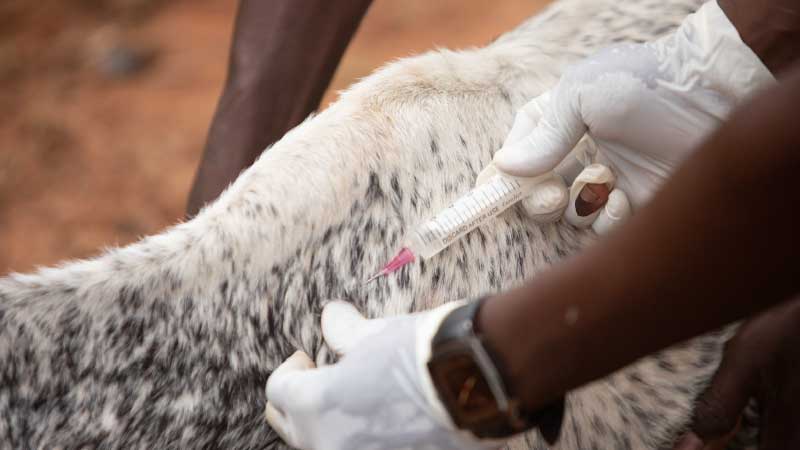
Habit 5: One needle per animal
When vaccinating or treating animals, change the needle between animals. Yes, every animal. A box of 100 disposable needles costs 1,500-2,500 FCFA (~$4.17). The cost of NOT changing needles: you transmit diseases like African swine fever, erysipelas, or pasteurella from one infected (but not yet symptomatic) animal to the entire herd in a single vaccination session.
If you absolutely cannot afford one needle per animal, at minimum use one needle per 5 animals and disinfect between with alcohol or flame. But the honest answer is: needles are cheap. Diseases are expensive.
Habit 6: Rodent and wild bird control
Rats and mice contaminate feed with urine and droppings carrying salmonella, leptospirosis, and pasteurella. Wild birds carry avian influenza and Newcastle disease. Control measures:
- Metal feed bins with tight lids (not plastic - rats chew through): 15,000 FCFA (~$25.0) each, 2-3 needed.
- Rat bait stations (locked plastic boxes with poison, safe from children and pets): 8,000 FCFA (~$13.3) each, place 1 every 20 meters around the perimeter.
- Wire mesh on all openings larger than 2cm (for wild birds and cats): 1 roll of 25m = 12,000 FCFA (~$20.0).
- Remove all standing water and tall grass within 30m of the poultry house - these are mosquito and rat breeding grounds.
Annual cost: about 50,000 FCFA (~$83.3). A single salmonella outbreak in your layers can cost you 500,000 FCFA (~$833) in lost production and culling. The rodent control pays for itself 10 times over.
Habit 7: Dead animal disposal (no open burning, no dumping)
Never burn carcasses in the open - the smoke carries pathogens for kilometers. Never dump in a pit that dogs, wild animals, or children can access. Two acceptable methods for small farms:
- Deep burial: dig a pit at least 2 meters deep, 100 meters from any water source and 50 meters from any animal house. Cover the carcass with quicklime (1kg per 50kg carcass) and 1 meter of soil. Mark the site. Total cost: 1 hour of labor + 2,000 FCFA (~$3.33) of quicklime.
- Composting (for birds only, not pigs): layer carcasses with sawdust/carbon material in a 1:3 ratio in a closed bin. After 30 days at 55+ degrees C internal temperature, only clean bones remain. The compost is safe for crops. Cost: a compost bin (200L) = 10,000 FCFA (~$16.7).
Habit 8: Visitor log and restricted access
Keep a notebook at the farm entrance. Every visitor signs in with name, date, time, purpose, and last farm visited. This costs 2,000 FCFA (~$3.33) (the notebook) and 0 effort. When there is an outbreak (on your farm or in the neighborhood), the log tells you exactly who might have brought it in - and who you need to warn if it started with you.
Restrict access to the animal houses themselves. Casual visitors (friends, family, neighbors stopping by to chat) should be received at the farm office or yard, not inside the poultry house. Every person entering the animal area is a biosecurity risk.
The full annual biosecurity budget for a small farm
- Footbath tray + disinfectant: 50,000 FCFA (~$83.3)/year
- Farm-only boots + overalls: 27,000 FCFA (~$45.0) (replaced every 2-3 years, so ~10,000/year amortized)
- Quarantine pen (one-time): 60,000 FCFA (~$100) amortized over 5 years = 12,000/year
- Disposable needles: 30,000 FCFA (~$50.0)/year
- Feed bins + rat bait + wire mesh: 50,000 FCFA (~$83.3) one-time, ~5,000/year replacement
- Quicklime for burials: 10,000 FCFA (~$16.7)/year
- Visitor log notebook: 2,000 FCFA (~$3.33)/year
Total: ~159,000 FCFA (~$265) per year. This is less than the cost of a single disease outbreak that culls 50 birds or 2 pigs. Biosecurity is the cheapest insurance you will ever buy.
The single biggest mistake to avoid
If you implement only one habit, make it #2 (farm-only boots). Most small-farm disease outbreaks are introduced by the farmer himself walking from the market, the agrovet, or a neighbor's sick pen directly into his own animal house. A pair of 6,000 FCFA (~$10.0) rubber boots left at the gate prevents more outbreaks than any other single measure on this list. Start there.
Sources & References
- [1] Cameroon cement price: 4,800 FCFA (Douala) / 5,100 FCFA (Yaoundé) per 42.5R 50kg bag, per cemnet.com and cameroonnewsagency.com. Source: https://www.cemnet.com
- [2] Newcastle vaccine pricing in Central Africa: 50 doses for 2,500 XAF (~50 FCFA/dose), per GALVmed 2017 field report. Source: https://www.galvmed.org
- [3] Biosecurity principles based on FAO Animal Production and Health Guidelines. Source: https://www.fao.org
FarmWise tracks all of this automatically for your farm.
Start free